
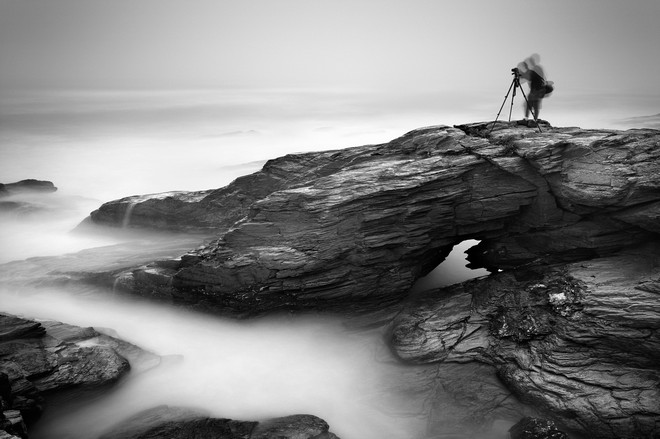
Photograph by William Brennan, 2011.
Artist Biography:
Blaine William Volden is a photographer and also a graduate of the Digital Photography Program at the Rhode Island School of Design (RISD/CE). He received his Architectural Drafting degree in his home state of Minnesota in 1999, moved to New England for a good while, and is now back in Minneapolis striving to become a "professional photographer". He began this venture as a hobby in 2000 photographing landscapes, nature, and wildlife using a Nikon FM-10 fully manual film camera. With influences such as pro photographers Lindsay Elgin, Shane Gutierrez, John Hames, David Fleurant, and William Brennan, he is pursuing proficiency within all aspects of photography.
Artist Statement:
Most of my images are about time. From hearing the quick snap of a fast shutter, to waiting patiently for the curtains to close on the scene before me, my photography is about time in more ways than one.
It’s about the hours, days, and years that I spend as a photographer witnessing a lighthouse emerge from the fog, the tide come in on the Atlantic, or paying attention to the smallest inner workings of urban landscapes. Those moments awaken a feeling that I am part of something beyond myself.
Long exposures and the use of multiple image layering in some of my photographs capture not only something for me to remember, but also the motion of the earth, and the atmosphere that surrounded me in that present frame of time. It’s easy to feel the history of our world and the people that have come before us, when I photograph ancient glacial rocks, rust forming on junk yard metal, or even a city skyline at night. I am invited into contemplation of the existence and future of all Mother and Human Nature's creations, including my own future as a soul on this planet at this given time.
Projects:
Angels, Rhode Island, 2012 (RISD/CE Final Project)
My favorite color has always been blue. While enrolled in the "History of Photography" at RISD/CE, I discovered the unique "Prussian" blue tones found within Cyanotypes, also called "Sun Prints." I studied the initial print processes employed by the early photographers in the 1800's, and was fully inspired by the work and thought that went into each image. I found myself wanting to employ one of these photographic print processes in my own image-making, if only to give it more validity. Indeed, some of my digital images seem to be merely snapshots after learning what these pioneers of photography endured. Cyanotypes are contact prints partially made by exposing images to light. Natural paper is made light sensitive by applying a mixture of potassium ferricyanide and ferric ammonium citrate. A photographic negative is then coupled with the paper between clear glass plates, and exposed to ultra violet rays. I used our Sun to expose these prints anywhere from ten to twenty minutes, depending on the time of day. The positive image is given a water bath, then hung to dry. In my final work I was challenged to select a subject that matched the process, and found photographing local historical headstone carvings from the late 1700’s to be a nice fit. This era saw the very beginnings of photography itself with the birth of some important figures in the medium. Anna Atkins, famous for her Cyanotypes of local plant-life, was born in 1799. I was drawn to these carvings of angels that can be found at Old North Burial Ground in Providence. I can only assume that in these carvings we are witness to one person’s art, and the extraordinary measures he or she went through to create each stone different from the next. That idea only seems logical, as each one of us is unique, and still different from the next.
Long Shot, Rhode Island, 2011
These photos constitute my final project while I was enrolled in the "Digital II" course at RISD/CE. I custom framed and matted each image using a Logan 751 Series Mat Cutter and made my "first prints" with a new Epson 3880. Each photograph was captured with time in mind. I obtained long exposures in camera, using a 10 Stop, Neutral Density Filter. This technique...well, more to come on that subject...
As I finished the Photography Program at RISD it's easy to become introspective after showing much my work to fellow students, guest critics, and my instructors. The title, "Long Shot", speaks not only to the exposure times , but my own feeling of where I stand in the world of Fine Art. I feel that going back to school to pursue "Professional Photography" has been the start of a new, long, meaningful journey...
The Arrow of Time, Rhode Island, 2012
The Arrow of Time as described by Physics Professor, Brian Cox:
“We never see waves traveling across lakes, coming together, and bouncing chunks of ice back onto glaciers. We are compelled to travel into the future... that’s because the ‘Arrow of Time’ dictates that as each moment passes, things change, for once these changes happened, they are never undone.”
The Arrow of Time as described by Physics Professor, Peter Coveney:
“The nature of time is central not only to our understanding of the world around us, including the physics of how the Universe came into being, and how it evolves, but it also affects issues such as the relation between science, culture, and human perception. Yet scientists still do not have an easily understandable definition of time... The problem is that in the everyday world, time appears to go in one direction - it has an arrow. Cups of tea cool, snowmen melt, and bulls wreak havoc in china shops. We never see the reverse processes. This unrelenting march of time is captured in thermodynamics, the science of irreversible processes.”
The Fall of 2012, Rhode Island, 2012
There is the eventual death of a leaf isn't there? Trees stay upright for as many years as possible, but every Fall season the leaves of the maple tree in my backyard die, and then cease to exist. While enrolled in a RISD/CE class titled, "Questioning Beauty" I tried to document this death and "The Fall" of a leaf. I was inspired by Sally Mann's photographs of death portrayed in her documentary, "What Remains". Indeed, some of these leaf images share the same tonality as photographs made throughout history depicting death and decay in human bodies. I was also forever changed by her words when addressing her "Family Pictures" series. She explains, "I have nothing but respect for people that travel the world to make art, who put exotic Indians in front of linen backdrops, but it's always been my philosophy to try and make art out of the everyday and ordinary...It never occurred to me to leave home to make art".
More words, but they're not mine:
"Without deviation from the norm, progress is not possible." - Frank Zappa
"I missed the boat once when I was young and stupid, but now I'm able to miss the boat repeatedly with great skill and accuracy." - Jon Fishman
"I believe in God, only I spell it Nature." - Frank Lloyd Wright
“It never occurred to me to leave home to make art.” - Sally Mann
Additional places to view some of my photographs:
Five Main Art Gallery, Wickford, Rhode Island
www.fivemain.com
www.pinholeday.org